I've been in homes where the HVAC system ran almost continuously and still couldn't keep up on a cold day. I've been in homes where the system short-cycled — turned on, reached setpoint quickly, turned off, turned on again, over and over — making the home feel alternately clammy and stuffy and never quite comfortable. Both of these problems are frequently caused by the same root issue: a system that was sized wrong from the beginning.
HVAC sizing isn't complicated in concept — you're trying to match the system's output capacity to the building's actual heating and cooling demand. But getting that match right requires knowing what the building's actual demand is, and that requires analysis. Rules of thumb skip the analysis. They assume that all homes of a given square footage have similar heating and cooling loads. They don't. Two 2,000 square foot homes can have dramatically different load profiles depending on their insulation, their windows, their orientation, their infiltration rate, and their local climate. A system sized correctly for one may be badly wrong for the other.
What Manual J is, and why it exists
Manual J is the ACCA (Air Conditioning Contractors of America) standard for residential load calculation. It's been around since 1986, it's referenced in the International Residential Code, and it's the industry-recognized method for determining how much heating and cooling a building actually needs. A Manual J calculation takes into account the building's envelope — wall area, insulation R-values, window U-factors and solar heat gain coefficients, infiltration rate, and ceiling insulation — as well as the local climate, the building's orientation, occupancy assumptions, and internal heat gains from equipment and lighting.
The result is a design heating load — the amount of heat the building loses on the coldest day of the year — and a design cooling load — the amount of heat the building gains on the hottest day of the year. These numbers tell you how much capacity the HVAC system needs to handle the building's worst-case demand. Equipment is then selected to meet those loads without significantly exceeding them.
The Manual S connection: Manual J tells you how big the system needs to be. Manual S — the companion standard for equipment selection — specifies how to choose equipment that meets the Manual J loads without oversizing. Contractors who do Manual J but then select equipment well above the calculated loads have done half the work. Both calculations matter.
Most HVAC contractors don't perform Manual J on residential projects. Some don't know how. Some know how but don't charge enough to cover the time it takes. Some perform a version of it — entering basic building data into software — without understanding the inputs well enough to know when the outputs are wrong. The result is an industry where the dominant sizing method is professional experience applied heuristically, which produces results that often work, but the homeowners don't know that they overspent on equipment and things could be better.
The two failure modes of wrong sizing
An incorrectly sized HVAC system fails in one of two directions, and each direction produces its own distinct set of problems.
Oversized systems: short-cycling and humidity
Oversizing is far more common than undersizing, because the professional instinct is to add a margin of safety — to ensure the system can handle whatever weather the building experiences. The logic sounds reasonable, but the results aren't.
An oversized cooling system reaches setpoint quickly and then shuts off. It runs in short bursts rather than long steady cycles. This is called short-cycling, and it creates several problems simultaneously.
First, comfort: temperature swings between cycles are wider, because the system blasts cold air, overshoots the setpoint, shuts off, and lets the space warm before turning on again.
Second, humidity: cooling systems remove moisture from the air while they run. A short-cycling system doesn't run long enough to adequately dehumidify the space, leaving homes feeling clammy even when the temperature is technically correct. In humid climates, this is a significant comfort problem.
Third, equipment life: compressors are stressed most at startup. A system that starts and stops frequently accumulates startup cycles faster than one that runs in long, steady cycles. Short-cycling shortens compressor life. The oversized system installed to provide a margin of safety may fail sooner than a correctly sized one would.
Fourth, efficiency: heat pumps specifically become most efficient when they run for long cycles. There's an electrical cost to starting up and getting ready to run, and then running the equipment harder to catch up from when it was off. Heat pumps run best when they run nearly constantly when heating or cooling this lets them constantly vary their output to the conditions always operating as efficiently as possible. Standard equipment is commonly dual speed, so an oversized unit will always run on low speed, but a properly sized unit would run at low and high speed as needed.
Undersized systems: the system that can't keep up
Undersizing is less common but equally problematic. I see this most commonly in homes with significant additions. An undersized system runs continuously on design days — the hottest expected summer days and coldest expected winter days — and still can't maintain setpoint. In a mild climate, this may not matter much; the system simply runs more than it would otherwise. In a cold climate, a heating system that can't maintain 68°F when it's −5°F outside is a serious comfort and safety problem.
Why high-performance homes require more careful sizing, not less
Here's where the connection to the rest of what I design becomes direct. A high-performance home — one with good insulation, tight air sealing, and high-quality windows — has a significantly lower heating and cooling load than a code-minimum home of the same size. That's the point. But it means that the rules of thumb developed for average construction are even further off for a high-performance building.
A contractor who sizes a conventional home at 1 ton per 500 square feet and applies that same ratio to a high-performance home will specify a system that's dramatically oversized. The result is the short-cycling problems described above — and they'll be worse in a tight, well-insulated building because the building holds temperature so well that the oversized system reaches setpoint even faster and cycles even more frequently.
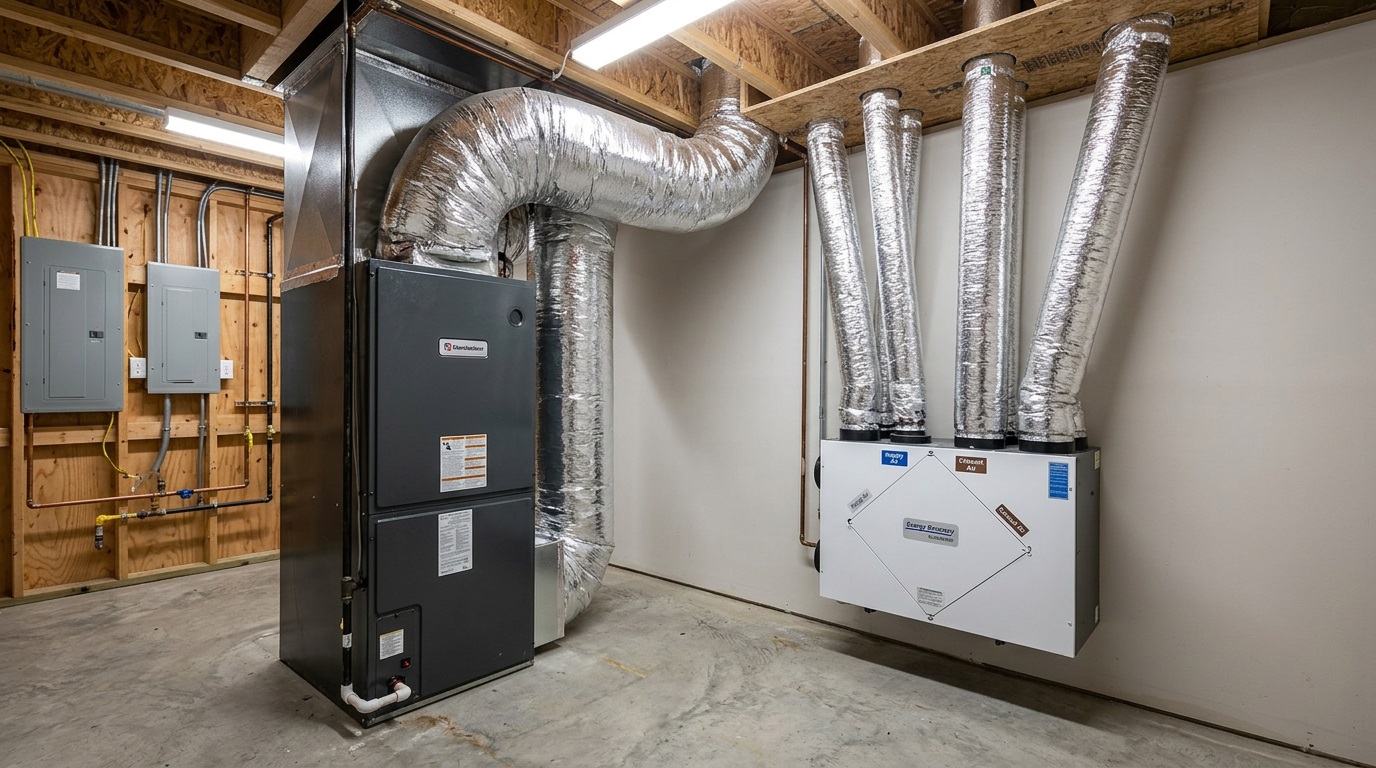
My basement has this problem. There were a number of reasons why we had to install a 1.5 ton unit when we only needed a 0.5 ton unit. So the heat doesn't run for very long when it comes on, where as the main level unit runs for hours right in the efficiency zone. The basement unit is running with as little power as it can, but it still making way too much heat for how much heat the basement is losing.
I've seen this pattern enough times that I consider proper load calculation a non-negotiable part of designing a high-performance home. The envelope work and the mechanical design have to be coordinated. You can't design an excellent building envelope and then hand off the mechanical to a contractor who's going to size by gut feel. The two systems need to be designed together, with the mechanical sized to match the designed performance of the envelope with no oversizing of equipment.
The duct system: the other half of the problem
Equipment sizing gets most of the attention in load calculation discussions, but duct design is equally important and even more commonly done poorly. Manual D is the companion standard to Manual J for duct system design — it specifies how to size supply and return ducts to deliver the right amount of conditioned air to each room without creating excessive pressure drop or velocity noise.
An undersized duct system restricts airflow, reducing the system's effective capacity regardless of how well the equipment is sized. An unbalanced duct system delivers too much air to some rooms and too little to others — the room at the end of a long duct run is always too warm in summer and too cold in winter, while the room nearest the air handler is aggressively conditioned. These are comfort problems that no thermostat can fix, because they're structural problems with the distribution system.
Proper duct design requires knowing the layout of the building, the location of supply registers and return grilles, and the airflow required in each zone based on the room's load — which comes back to Manual J. Everything in the mechanical system traces back to having accurate load data for the building and each room
A question worth asking your HVAC contractor: "Did you do a Manual J load calculation, and can I see it?" A contractor who did the calculation should be able to show you a report. If the answer is vague — "we use our experience" or "we size based on square footage" — that's useful information. It means the system is being sized by heuristic rather than analysis.
What this looks like in the drawings I produce
The High-Performance drawing package I offer includes a detailed HVAC plan because I've found that HVAC design left to the contractor's discretion — without drawings — produces results that are inconsistent with the performance of the building envelope. The plan specifies equipment capacity based on a load calculation performed for that specific building, duct routing through the building with sizes and register locations, and ventilation strategy including fresh air introduction.
This doesn't mean I'm doing the HVAC contractor's job. What it means is that when a mechanical contractor looks at my drawings, they have a load calculation to work from, a duct layout to follow, and register locations that were chosen based on the room's thermal characteristics rather than whatever was convenient to rough in. They can bid the job accurately because the system is specified. And when the system is installed, it performs as designed rather than as estimated.
The building envelope and the mechanical system have to be designed together. A tight, well-insulated building with an oversized, poorly distributed HVAC system is not a high-performance home — it's a well-insulated home with a comfort problem. Getting both right requires doing the analysis, and doing it before any equipment is ordered or any ductwork is cut.