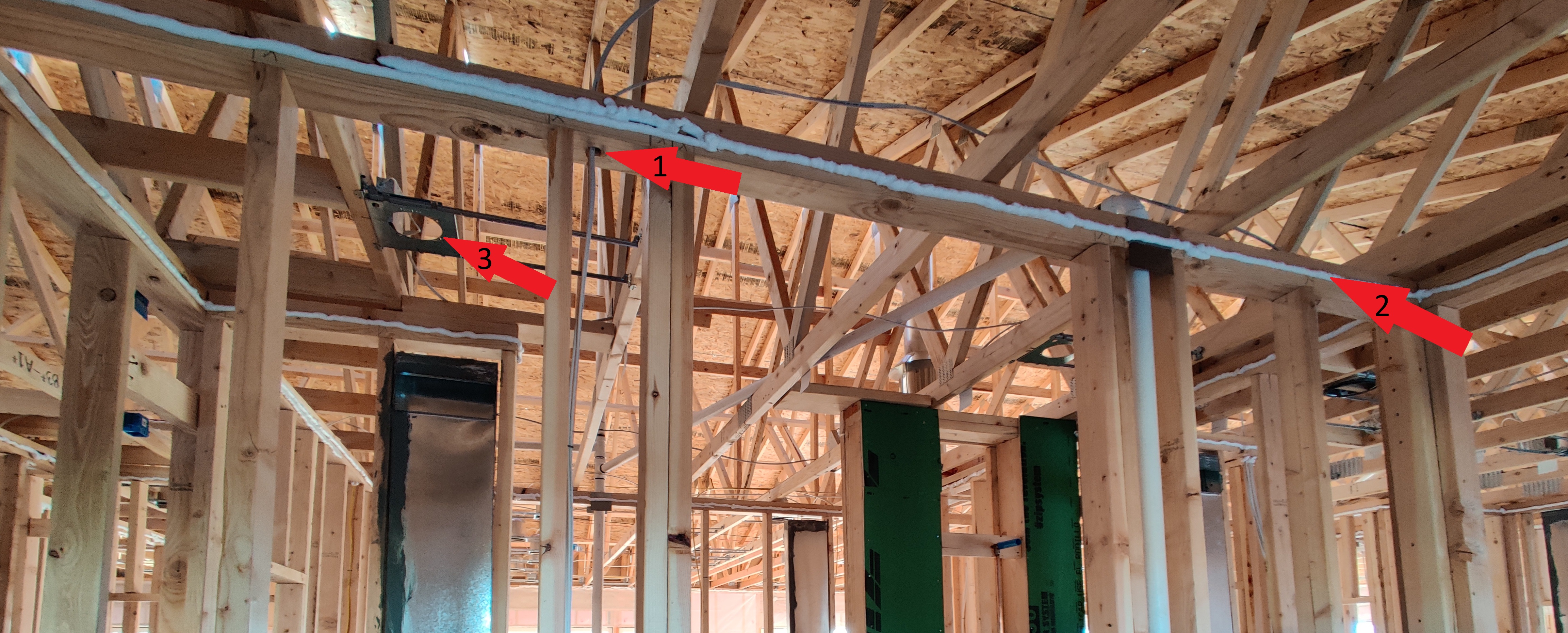
Every homeowner I've ever talked to knows what insulation is. Almost none of them know what air sealing is. The insulation industry has marketing, branding, and forty years of R-value messaging behind it. You can see it. If you are over 35 you probably have bad memories of touching it. Air sealing has a blower door test and a number that most people have never heard of. And yet, if I had to choose between a well-insulated home with poor air sealing and a modestly insulated home with an excellent air barrier, I'd choose the second one without hesitation.
This isn't a theoretical argument. I designed and built my own home with both things in mind, and I can tell you from daily experience what the result feels like. In winter, the air temperature at the floor and the ceiling of my living room is nearly identical. There are no drafts near the windows. The furnace runs quietly in the background and doesn't have to work hard to maintain temperature. None of that is expensive equipment or exotic systems — it's a standard forced-air system doing exactly what it should, in a building envelope that's not fighting against it.
What air sealing actually is
Insulation resists heat transfer by conduction — heat moving slowly through a solid material. The R-value number measures how well it does that. A higher R-value means the material slows conductive heat flow more effectively.
But heat also moves by convection — warm air physically moving from one place to another, carrying its energy with it. Insulation does almost nothing to stop convective heat loss. If air can move through or around your insulation, the insulation's R-value isn't helping, only it's density is. It's acting like an air filter!
Air sealing is the practice of creating a continuous, unbroken barrier around the conditioned envelope of your home — the layer that separates inside from outside — that air cannot pass through. Not reduced. Not slowed. Cannot pass through. Every gap, penetration, transition, and junction is detailed and sealed. When it's done correctly, the only air entering or leaving the building is the air you intentionally introduce through a controlled ventilation system.
"If air can move through your insulation, the R-value is largely irrelevant. You have an air filter."
The practical implication is significant. When designing my own home I had to decide how to effectively spend my money. Adding extra insulation can get very expensive and doesn't help much after a certain point. My home has 2x6 walls with blown in fiberglass and 2" of XPS insulation around the outside. That wall assembly has an effective R value of about 25. Going beyond that level gets very expensive and doesn't buy any more performance in my climate. Money spent on air sealing still buys an additional 10% reduction in heating needs! That is literally the same difference as taking a home with zero insulation in the walls and adding the normal amount of insulation to them!
Where the air goes — the five locations that make or break a building
Air leakage concentrates in predictable locations. These aren't random — they're the places where the structure changes, where trades make penetrations, and where literal holes are left in the house like in my Washington home.
1. The rim joist
The rim joist sits at the intersection of the foundation wall, the floor framing, and the sheathing. It's one of the most consistently problematic air leakage locations in residential construction because it's a junction of multiple materials — concrete, wood sill plate, rim board, and sheathing — none of which seal naturally against each other. Cold air infiltrates here in winter and pushes warm air up through the ceiling just like a chimney. Sill tape helps stop this and is standard on all construction projects, but it can't solve the problem alone. The only solution is to seal the sheathing to the foundation which completely eliminates that problem area.
2. The top plate
At the top of every exterior wall, the framing meets the ceiling plane. This junction is rarely airtight. Electrical wires pass through it. Plumbing vents pass through it. The framing members themselves may have gaps where they don't land squarely. In a home with an unconditioned attic (most homes), this is the boundary between conditioned living space and the attic that will be at least 10-20°F hotter than outside in July and about the same temperature as the outside in January. An unsealed top plate lets that unconditioned air directly into your wall cavities and insulation. It is standard practice to seal all penetrations in the top plate, but that does not address the gaps between the sheathing and the top plate or the drywall and the top plate. Air will still pass through those places around the insulation.
3. Electrical and plumbing penetrations
Every outlet box on an exterior wall is a hole in the envelope. Every pipe that passes through an exterior wall or floor is a gap around it. Individually, these are small. Collectively, across the entire house, they add up to a significant opening. The fix is simple to talk about — foam or caulk at every penetration — but harder than it sounds to do successfully. The materials in these locations often do not work well with foam or sealants alone or multiple items are run through a single penetration which makes it much harder to seal completely.
4. Window and door rough openings
The gap between a window frame and the rough opening framing around it is a direct path for air infiltration. This is because the bottom of a window is often left unsealed to the exterior to allow water to drain out. That gap is often stuffed with fiberglass batt or spray foamed with open cell foam during insulation which slows air movement, but doesn't prevent it. Proper detailing requires sealing on the interior at every window and door opening to prevent air leakage, but remain invisible after trim is installed.
5. Recessed lighting
This is the most challenging one. A standard recessed light fixture installed in a ceiling below an attic or unconditioned space is, from an air sealing standpoint, a large intentional hole in your building envelope. The fixture housings say they are airtight, but that is a marketing term meaning that they are essentially air tight compared to their predecessors. They are not airtight. Especially when used by the dozens. The best solution is to avoid ceiling recessed lighting in locations where it penetrates the thermal boundary, and use surface-mounted or wall-mounted fixtures instead. That is only best for air sealing, not for people. Direct task lighting is often best done with ceiling mounted lights and recessed can lights give flexibility in bulb selection. I have nearly 100 holes in the ceiling on the main level of my home for lights and smoke detectors. There just wasn't another way to get the light I needed where I needed it so I had to find a way to air seal them all. I don't regret it.
How leakage is measured — the blower door test
The standard tool for measuring a building's air tightness is a blower door test. A large fan is temporarily mounted in an exterior door opening and calibrated to depressurize the building to 50 Pascals below outdoor pressure — a moderate pressure difference roughly equivalent to a 20 mph wind hitting all sides of the house simultaneously. The fan measures how much air it has to move to maintain that pressure difference. More air flow means more leakage.
The result is expressed in ACH50 — air changes per hour at 50 Pascals. This number represents how many times per hour the entire volume of air in the house would be replaced if the house were continuously exposed to that 50 Pascal pressure difference. A lower number is better.
A note on the 50 Pascal convention: Real buildings aren't continuously exposed to 50 Pascals of pressure difference — that's a test condition, not a normal operating condition. To estimate natural air change rate under typical conditions, a common rule of thumb is to divide the ACH50 result by 20. So a building testing at 5 ACH50 exchanges air at roughly 0.25 ACH under normal conditions — about once every four hours.
What the targets mean in practice
Current code in most U.S. jurisdictions requires new construction to achieve 5 ACH50 or better. This varies by climate zone and local amendments and enforcement isn't uniformly applied even when it is required by code. That's the minimum, not the goal. Using modern building materials a contractor can often get to 5 ACH50 if they are careful, but energy consultants frequently test homes that performs much worse than that. A thoughtfully built home without extraordinary effort should achieve 3 ACH50. A genuinely well-sealed home can hit 1 ACH50. Passive House certification requires 0.6 ACH50 which is past the point of diminishing returns. 1 ACH50 is about where you stop getting good value for money and it becomes very expensive to continue.
These numbers have real consequences for comfort. At 5 ACH50, you're meeting code. You'll likely have noticeable drafts near windows on cold windy days. The corners of rooms will be cooler than the center. The floors will be cold in winter because infiltration tends to enter low and exhaust high, creating a convective loop that keeps cold air near the floor. Your heating system will cycle more frequently and struggle to maintain consistent temperature.
At 1–3 ACH50, the building behaves fundamentally differently. Infiltration is low enough that the ventilation system — not random air movement — controls where fresh air comes from and where stale air goes. The thermal envelope holds its temperature with less mechanical assistance. The HVAC system needs to be sized smaller so that it runs in longer, quieter cycles and doesn't fight the building. That floor-to-ceiling temperature consistency I mentioned at the beginning becomes achievable because you've eliminated the convective loops that cold infiltration creates.
The ventilation question
One comment that comes up often when talking about air sealing is "But don't houses need to breathe?" They don't. That phrase has been used for decades to justify inadequate construction — it conflates accidental infiltration with intentional ventilation, and treats an engineering failure as a feature.
People need to breathe. People need fresh air. Fresh air and air leakage are not the same thing. A leaky building delivers fresh air randomly — from wherever the wind is blowing, through whatever gaps exist, carrying outdoor pollutants, humidity, and allergens with it. A tight building delivers fresh air deliberately — through a mechanical ventilation system that introduces it at a controlled rate, from a known location, and often through a heat recovery ventilator (HRV) or energy recovery ventilator (ERV) that captures the energy from outgoing stale air to pre-condition the incoming fresh air saving energy.
The tighter the building, the more control you have over the air inside it. That's not a problem — it's the point.
HRV vs. ERV: A heat recovery ventilator transfers heat between the outgoing and incoming air streams. An energy recovery ventilator transfers both heat and moisture. It used to be that an HRV was preferred in dry climates, but these days ERVs have become the default choice and perform well in most situations. If your build needs one I'll assess if an ERV is the best choice for your climate.
What careful air sealing actually requires
None of this is technologically complicated. There are no exotic materials involved. Spray foam, sealant, backer rod, air barrier membranes, and tapes have been available for decades. The challenge is almost entirely one of attention and sequence — knowing where to seal, doing it at the right point in construction before access is lost, and verifying the result before the wall closes. There are many strategies to choose from. Some can be expensive but justified, but often cheaper effective solutions are available.
The verification part is critical, and it's the step that too often doesn't happen. The best practice is to test as early as possible. This will be different depending on the air sealing strategy designed. At this stage the cost will be lower if a repair is needed than if the house is tested when the house is finished.
What this means for how I design for clients
The High-Performance drawing package I offer includes air sealing and envelope detail drawings specific to your home and your goals. Sometimes a conditioned attic is the best solution, sometimes a false ceiling is best, sometimes multiple solutions are needed. Without these details being clearly communicated you will be relying on luck. You might end up with a fairly comfortable house at 5 ACH50 or you might end up with my old house with a hole big enough for a racoon to get through in the building envelope.
With drawings, the locations of the air barrier are specified, the materials at each transition are called out. You can trace your finger around the entire building envelope air barrier without lifting it.
The result isn't a more expensive home. It's a more comfortable one — and in the long run, a less expensive one to heat and cool. The materials and labor cost is usually low compared to the long term value. If it isn't, I'll let you know why and help you decide if we should adjust the project goals.
"In my home, the floor and ceiling temperatures are nearly identical. That's not expensive equipment — it's a building envelope that isn't fighting the system trying to condition it."
If you're planning a build and you've spent time thinking about insulation R-values but haven't thought about air sealing targets, this is a good moment to reorder those priorities. Ask your designer what ACH50 result the building is targeting. Ask what the air barrier strategy is and where it's detailed on the drawings. If the answer is vague, that's useful information — and the right time to address it is before anything is built.